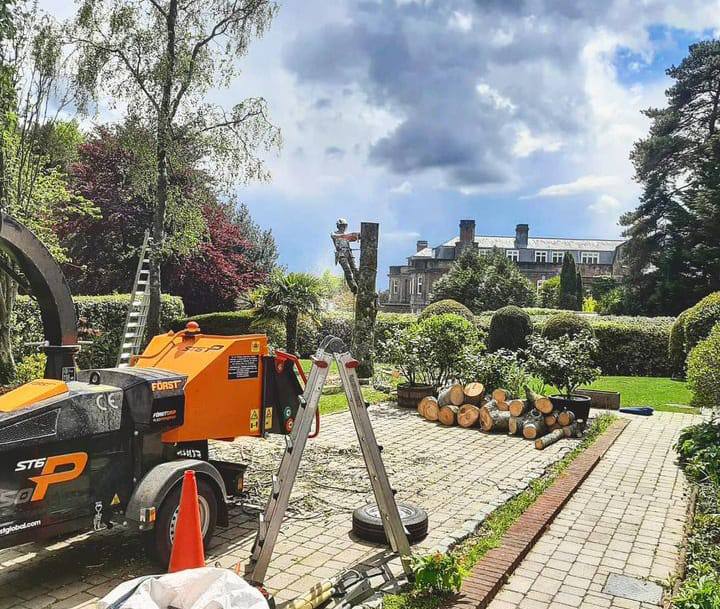
Tree Leaning More Than Usual? Signs It Needs Professional Attention
A leaning tree is not automatically a dangerous tree. Many trees grow naturally at an angle and remain stable for decades, particularly where their shape has developed gradually in response to available light, surrounding vegetation or local growing conditions. What deserves greater attention is a tree that appears to be leaning more than it did previously.
A noticeable change in position can sometimes indicate movement within the root system, changes in the surrounding ground or structural weakness within the tree. For homeowners in Brixworth, Northamptonshire, recognising these changes early can help determine when a professional tree assessment is appropriate.
At Brixworth Tree Surgeons, we assess trees individually, looking beyond the visible lean to understand the condition of the roots, trunk, crown and surrounding ground before recommending any tree surgery.
Is a Leaning Tree Always a Problem?
No. The distinction between a long-established lean and recent movement is extremely important.
Some trees develop angled trunks while young and gradually adapt their growth around this position. Their root systems and crown structures develop accordingly, meaning the lean itself may simply be part of the tree’s natural form.
A tree that has recently changed angle is different.
If a previously upright tree begins leaning, or an existing lean becomes noticeably more pronounced, professional attention is sensible. Something may have changed in the relationship between the tree, its roots and the ground supporting it.
1. The Lean Has Appeared Suddenly
One of the clearest reasons to arrange an assessment is a sudden change in the tree’s position.
This may become noticeable following:
- Strong winds
- Prolonged wet weather
- Significant ground saturation
- Damage to surrounding soil
- Changes around the root area
Comparing the tree with older photographs can sometimes help establish whether its angle has genuinely changed.
A sudden lean should not simply be treated as a cosmetic issue. The reason for the movement needs to be understood.
2. The Ground Is Lifting Around the Base
When a tree begins moving at root level, changes may sometimes become visible in the surrounding soil.
Look carefully from a safe distance for signs such as raised ground on one side of the tree or newly disturbed soil around the base.
This can be particularly significant where these changes have appeared alongside an increasing lean.
Roots provide the tree with its essential anchorage. Visible movement around the rooting area therefore deserves professional assessment rather than waiting to see whether the tree moves further.
3. Cracks Have Appeared in the Surrounding Soil
Fresh cracks around the base can also indicate that the ground has recently moved.
This does not automatically mean that the tree is about to fail, as soil can crack for various reasons. However, when new cracks appear at the same time as a noticeable change in the tree’s angle, the combination warrants closer investigation.
A professional tree surgeon can assess whether the changes are related to the tree’s stability or have another explanation.
4. The Root Area Has Been Disturbed
Trees depend heavily on their root systems for both stability and access to essential resources.
Changes around the base of an established tree can therefore have consequences that are not immediately visible within the crown.
Ground disturbance close to a tree may alter the conditions around important roots. If the tree subsequently begins leaning more noticeably, an assessment can help establish whether its anchorage has been affected.
The visible trunk is only one part of the tree. Understanding what is happening beneath and immediately around the ground is equally important.
5. There Are Cracks or Splits in the Trunk
A leaning tree should also be examined for visible structural changes within the trunk.
Cracks, splits or damaged unions can indicate that particular sections are under considerable mechanical stress. These features become especially relevant when combined with a recent change in the tree’s position.
Signs worth noting include:
- Newly visible cracks
- Splitting around major branch unions
- Areas of damaged or separating wood
- Significant cavities
- Sections of obvious deterioration
Avoid attempting to investigate large trees at height yourself. A ground-level observation is sufficient to decide whether professional assessment is needed.
6. The Crown Has Become Heavily Weighted to One Side
Trees do not always develop evenly.
Competition for light, previous pruning and surrounding obstacles can result in considerably more growth on one side of the crown. A tree may therefore have long, substantial limbs extending in one particular direction.
An uneven crown does not automatically make a tree unstable, but it forms part of the overall picture when assessing a noticeable lean.
Professional tree surgeons consider how the crown’s weight is distributed in relation to the trunk, roots and surrounding environment.
Where appropriate, carefully planned pruning may form part of the management approach. However, crown reduction should be selective and based on the individual tree rather than simply cutting back branches as heavily as possible.
7. The Tree Has Changed Following Strong Weather
Trees naturally move in windy conditions, but strong weather can sometimes expose existing weaknesses or cause new damage.
After particularly difficult conditions, you might notice:
- A greater angle than before
- Broken branches
- Fresh cracks
- Disturbed ground around the roots
- Hanging limbs
- Newly exposed roots
- Changes within the crown
The important factor is change.
If the tree looks noticeably different following strong winds, arranging professional attention can establish whether it remains structurally suitable or requires remedial work.
8. Roots Have Become Newly Exposed or Damaged
Some surface roots are completely normal, particularly on mature trees. Concern is more appropriate when roots have become newly exposed, broken, lifted or otherwise visibly changed.
A tree’s stability depends on a broad root system rather than one individual root, so its condition cannot be judged accurately by looking at a single exposed section.
Professional assessment considers the root area alongside the tree’s overall structure.
This is particularly important when root changes coincide with an increasing lean.
9. The Lean Is Towards a Frequently Used Area
The surroundings matter when considering any tree concern.
A structural feature that deserves monitoring in an open part of a garden may require greater attention when the tree is positioned close to frequently occupied spaces.
A leaning tree may extend towards:
- A house
- Garden seating
- A driveway
- A path
- An outbuilding
- Frequently used parts of the garden
Professional assessment considers not only the tree itself but also what surrounds it.
For homeowners in Brixworth, this provides a more useful picture than judging a tree purely by its angle.
A Healthy-Looking Crown Does Not Tell the Whole Story
It can be tempting to assume that a tree must be stable because its leaves appear healthy.
However, foliage condition and structural stability are not the same thing.
A tree may continue producing leaves while having structural concerns elsewhere. Equally, sparse foliage does not automatically mean that a tree is structurally unstable.
Assessing a leaning tree therefore involves considering several components together, including:
Root Condition
The root system provides essential anchorage.
Trunk Structure
Cracks, cavities, decay and previous damage can influence structural condition.
Branch Distribution
Large or unevenly distributed limbs affect how the tree’s weight is arranged.
Surrounding Ground
Soil movement and changes around the base can provide useful clues about recent movement.
No single feature should necessarily be considered in isolation.
What Can Professional Tree Surgery Do?
The appropriate response depends entirely on why the tree is leaning.
Professional assessment may determine that the tree simply has a longstanding natural lean and does not require significant intervention. In other cases, tree surgery may be appropriate to manage particular concerns.
Possible work could include selective pruning, crown reduction, removal of damaged branches or, where retention is no longer considered appropriate, controlled tree removal.
The key point is that the correct solution comes after assessment.
Cutting branches from a leaning tree without understanding the cause of the problem is not an appropriate substitute for evaluating its overall condition.
Why Crown Reduction May Sometimes Be Considered
Where the tree is suitable for retention but has an excessively large or unbalanced canopy, crown reduction may sometimes form part of its management.
Professional crown reduction selectively reduces the dimensions of the canopy while aiming to retain a natural, balanced structure. It is very different from indiscriminately cutting back major branches.
Whether this is appropriate depends on the species, condition, structure and circumstances of the individual tree.
It should not be assumed that reducing the crown will solve every problem associated with a leaning tree.
Avoid Trying to Correct a Large Lean Yourself
Large-tree work requires considerably more than basic garden pruning.
Branches can be extremely heavy, and their behaviour once cut is not always obvious from ground level. Working on a tree where stability is already uncertain adds another consideration.
Attempting to remove substantial branches without understanding the tree’s structure may also alter how weight is distributed through the crown.
Professional tree surgeons can assess the tree first and plan any necessary work around its condition and surroundings.
Why Early Assessment Can Be Valuable
A common mistake is waiting until a leaning tree becomes dramatically different before seeking advice.
Subtle changes can provide useful information.
If you regularly see the tree from the same window, driveway or part of the garden, you may be particularly well placed to recognise when something has changed.
Taking notice of a gradually increasing lean, newly disturbed soil or fresh trunk damage allows the tree to be assessed before further changes potentially occur.
Professional assessment does not automatically lead to extensive tree surgery. Sometimes monitoring or limited work may be more appropriate.
Professional Tree Assessment in Brixworth
Trees should be assessed as complete living structures rather than simply as trunks and branches.
At Brixworth Tree Surgeons, we consider the visible condition of the tree, its crown structure, surrounding ground, root area and relationship with nearby features when assessing a noticeable lean.
The objective is to understand why the tree has changed and determine what, if anything, should be done.
This considered approach helps avoid unnecessary pruning while ensuring genuine concerns receive appropriate professional attention.
Conclusion
A tree that has always leaned may simply have developed naturally that way. A tree that is leaning more than usual, however, deserves closer attention.
Sudden changes in angle, lifting soil, fresh ground cracks, exposed roots, trunk damage, an increasingly unbalanced crown and movement following strong weather are all sensible reasons to arrange a professional assessment.
The appropriate solution will depend on the cause. Some trees may require little intervention, while others could benefit from carefully planned pruning or more substantial tree surgery.
If you have noticed a tree changing position in your garden in Brixworth, Northamptonshire, Brixworth Tree Surgeons can assess its condition and advise on the most appropriate approach. Contact our team for professional tree surgery focused on managing the individual needs of your trees and their surroundings.
Call us on: 01604 279 593
Click here to find out more about Brixworth Tree Surgeons
Click here to complete our contact form and see how we can help with your tree needs.